Design the architecture.Direct the agents.Own the decisions.
Architect lets you design your system exactly the way you want, then sends the agents to build it. Map out components, group them into zones, and dispatch a variety of agentic CLIs from one unified, shared context.
Pilot program open: limited early access
Works with your CLI
Bring whatever agent you already use.
The problem
"The code shipped. The understanding didn't."
AI-generated code gets hard to understand the moment you stop watching every token. A week later, the output is real, but the reasoning behind the system is scattered across terminals, prompts, and memory.
Managing multiple agent CLIs only makes that worse. One tool handles the backend, another touches the UI, a third patches release flows, and you are left reconstructing the architecture after the fact.
How Architect fixes this
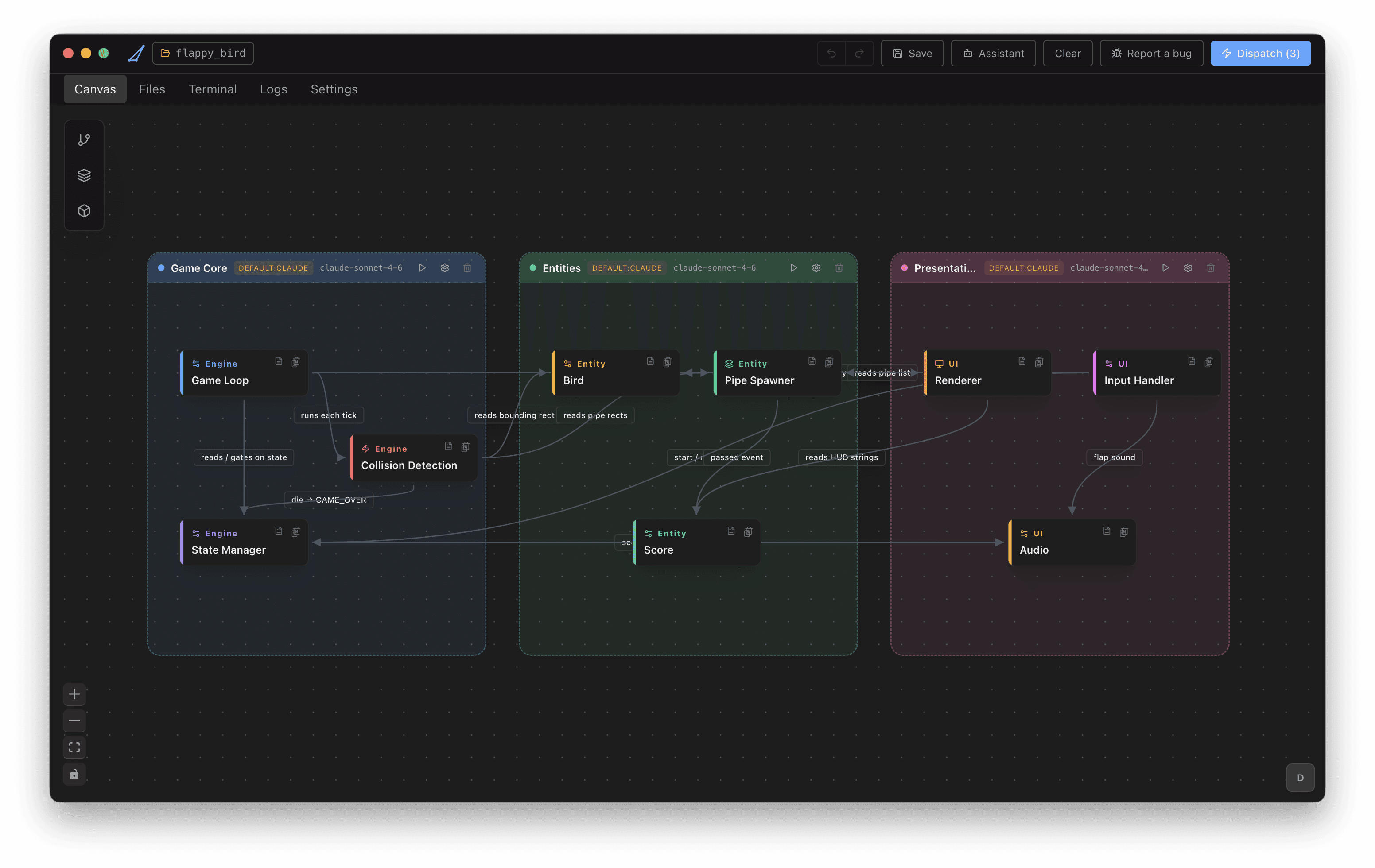
Architect gives you one platform and one system map. You define the application with components, group those components into specialist zones, and keep the whole architecture visible while work moves.
Parallel agents still run, but they run at the zone level across technical areas of the architecture. Any mix of agentic CLIs can contribute, and the result stays understandable, coordinated, and ready to ship.
one architecture map, specialist zones own technical slices
How it works
From whiteboard to deploy
Map the zones
Lay out the core components of your application, then group related components into technical zones. Keep the map high-signal: what exists, what connects, and where specialist work should run.
Write zone briefs
Describe what each zone owns, what good output looks like, and what boundaries matter. Keep the architecture understandable before the code starts moving.
Zones move together
Architect coordinates parallel work across specialist zones, so multiple agent CLIs can build technical slices of the same application without breaking the architecture map.
Everything your architecture needs
From first commit to production deploy
01
Parallel zones, one conductor
Every zone launches concurrently in its own CLI session. A conductor agent coordinates handoffs through a shared mailbox, so zones move in parallel without losing the bigger picture.
02
Conductor-coordinated handoffs
You own the zone map. The conductor reads zone results as they land, plans the next round of work, and routes tasks between zones without manual handoff choreography.
Database
Auth
API
Frontend
Infra
03
Context threading
Each zone inherits the architecture context it needs, so generated work stays legible and connected to the whole system.
04
Session capture & resume
Every zone’s CLI session is recorded to ARCHITECT/sessions/. Relaunch a zone and pick up the exact conversation. Works across Claude Code, Codex, Gemini, and OpenCode.
05
Live agent log
Watch zones report progress in real time without losing the system-level picture.
06
Runtime and stack agnostic
Any of Claude Code, Codex, Gemini, or OpenCode per zone. Your project code stays in your repo. Architect coordinates around it, not through it.
Architecture
Your system, mapped as zones
Architect groups your components into zones (frontend, backend, database) so agents work on the right slice of the system.
Frontend Zone
UI Components
React views, forms, and layout primitives.
Router
Pages, navigation, and client state.
Backend Zone
API Routes
Request handlers and business logic.
Auth Service
Sessions, tokens, and access control.
Database Zone
Postgres
Primary relational store with migrations.
Redis
Session cache and rate limiting.
Under the hood
What's actually happening
The visual canvas saves to architect-canvas.json. On dispatch, Architect compiles it into a runtime manifest, spawns one CLI session per zone, and records every step under an ARCHITECT/ folder beside your code.
When you click Dispatch, Architect freezes the canvas into ARCHITECT/manifest.json: one entry per zone with its participant id, runtime, system prompt, owned components, and the activity, state, and output paths the conductor will read and write during the run.
Ready to hand off the busywork?
Early access runs through a dedicated intake flow now. Tell us about your team, platform, and use case so we can route the right pilot access.
Basic lead intake only. No spam. We'll follow up when your pilot lane opens.